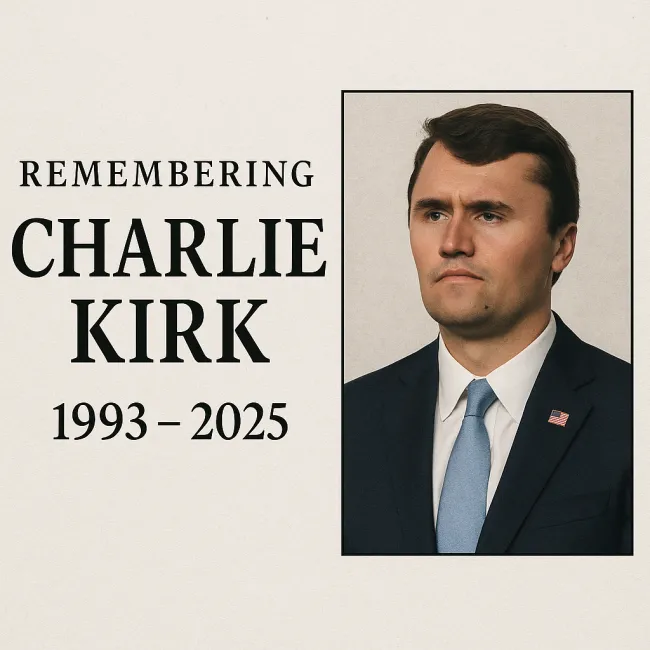
Charlie Kirk was assassinated in a cowardly attack on 10 September 2025 during a public event at Utah Valley University. That act was an attack on open debate itself, not only on one man.
He was the founder of Turning Point USA (TPUSA) and, by 31, one of the most prominent voices in American campus politics and broadcasting. He mobilised a new generation of young conservatives and forced national conversations that others preferred to avoid.
His contributions extended beyond the United States. In December 2018 he helped launch Turning Point UK alongside Candace Owens at a London event that attracted significant political and media attention. The organisation set out to replicate in Britain the same energy he had generated among students in America, championing free speech and challenging what he called the dominance of “woke” ideology on campuses.
Kirk’s visits to Britain included speaking engagements in London, Manchester, and student debates at leading universities. At Cambridge in particular, his presence sparked fierce arguments about whether universities should host speakers whose views challenged prevailing orthodoxies. Kirk’s position was consistent: universities exist to test ideas, not to shield students from them. In standing with young British activists, he encouraged them to resist the growing culture of censorship and intimidation that sought to shut down legitimate debate.
His core argument was simple. Free speech is the first liberty. If people cannot speak, they cannot challenge power, test ideas or correct mistakes. He chose to make his case in public, to take questions, and to accept the risks that come with visible advocacy. The bullet that killed him was aimed at that principle as much as at the man.
The challenges to free speech remain. Powerful platforms can silence lawful views at scale. Governments reach for speech controls in the name of safety. Cultural gatekeepers use boycotts and no-platforming to punish dissent. Universities that should prize argument too often police language and belief. None of this makes our societies safer or wiser. It only drives division underground and leaves the field to those who would rather intimidate than persuade. Places of higher education become echo chambers for a single perspective, and dissenting voices are unwelcome. Regardless of whether someone agreed with Kirk's views or not, he had a right to express and debate them.
In public life our job is to defend the space where disagreement can happen without fear. That means clear legal protections for lawful expression, even when it offends. It means a policing model that targets violence, not opinions. It means universities and civic institutions that protect pluralism and debate rather than manage them out of sight. It also means drawing a hard line against political violence in every form, whoever the target may be.
We should also remember the human cost. Charlie leaves behind his wife, Erika, and their 2 young children. Their loss is immeasurable and they carry the greatest burden. They deserve our respect, and privacy as they grieve.
To honour his memory we should do the work that matters now. Protect the right to speak. Challenge censorship and intimidation wherever they arise. Insist that persuasion, not force, governs our public square. A free country only stays free if its people are allowed to argue in the light.